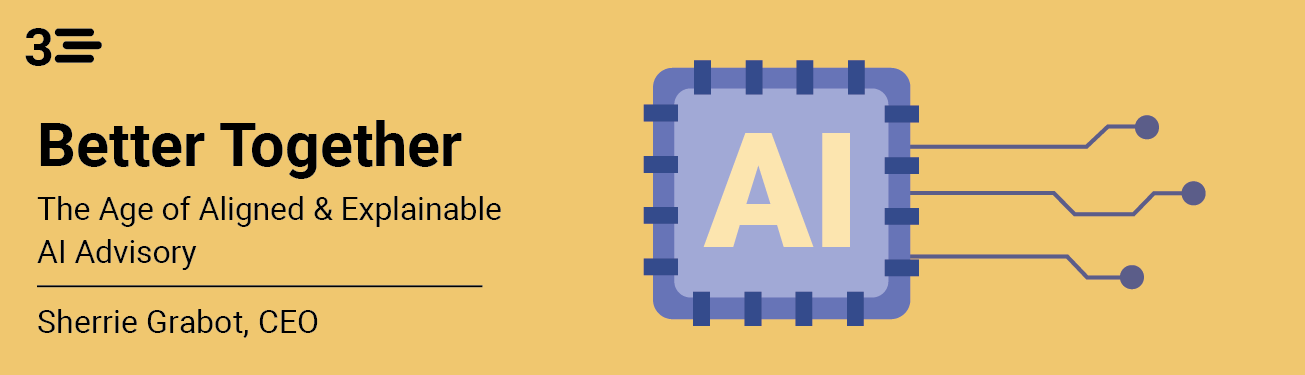
Better Together
The Age of Aligned & Explainable AI Advisory
After helping build some of the nation’s earliest 401(k) systems in the 1980s and co-founding GuidedChoice with Nobel Laureate Dr. Harry Markowitz in 1999, my goal has always been simple: use technology to deliver personalized financial guidance to more people. That early venture proved that innovation, when grounded in the right principles, can empower everyday individuals. Today, we stand at the dawn of another revolution.
With agentic AI, we have the power to put a financial advisor in everyone’s pocket. But this promise only works if our AI advisors are aligned—explainable, expertly evaluated, and rooted in ethical values that keep the client’s best interests at the center.
Technology alone is not a panacea. In finance especially, trust, transparency, and empathy remain the bedrock of good advice. Human advisors are bound by fiduciary duty to act in a client’s best interest. We should expect nothing less from AI.
That means building systems that do the right thing even when it’s hard—always placing the individual’s needs before any other agenda. Alignment isn’t just a technical tweak; it’s a moral commitment.
Why Explainability Matters
AI has enormous potential, but it cannot operate as a “black box.” If people don’t understand why an AI recommended something, trust erodes. In finance, where decisions shape futures, opacity is unacceptable.
This is where Explainable AI (XAI) comes in. XAI makes recommendations understandable, showing the justifications behind the various decisions. That transparency allows people to question, validate, and ultimately trust the advice.
A 2025 Northwestern Mutual Planning & Progress Study found that 55% of those asked trust human advisors more than AI, while only 15% fully trust AI guidance. The trust gap is clear. Explainability is how we bridge it.
Other industries prove the point:



Finance deserves the same clarity.
Guardrails and Independence
Regulators are moving fast. The EU’s AI Act emphasizes the right to understandable explanations for high-stakes AI decisions. The latest Deloitte Connected Consumer study shows that while Americans are embracing generative AI in their daily lives, many believe technology is advancing too quickly without enough transparency or safeguards. Consumers want innovation, but they also want responsibility: clarity about how data is used, control over their personal information, and confidence that their privacy is protected. In finance, where decisions carry lifelong consequences, this demand for transparency isn’t just a preference it’s a prerequisite for trust. Fintech providers that prioritize explainability and user control will be best positioned to earn lasting credibility.

But guardrails and compliance are just the baseline. At 3Nickels, we go further: our platform is built as an independent fiduciary. Our agentic orchestration is held to the same standards of transparency and objectivity for the client’s goals.
That might mean recommending a low-cost option over a pricier one or telling someone they need to save more instead of offering easy reassurance. Independence, backed by explainability, is how we prove loyalty.
Human + AI Collaboration
This is not AI versus advisors. In fact, many people prefer a human advisor who leverages AI tools. The winning model is collaboration:


Explainability is the bridge. When AI can walk through its reasoning in plain language, clients feel empowered, and advisors gain sharper insight. And even those who may never meet a planner in person can benefit: an aligned, explainable AI can nudge good habits, celebrate progress, and discourage rash moves when markets get volatile.
A Future Worth Striving For
This new era feels like a return to the timeless principles that have always defined trusted advisors: excellence, honesty, and doing good for others. By aligning smart algorithms with human values—and making their reasoning transparent—we can democratize high-quality guidance.
That means accessible advice for a single mother juggling two jobs, a young couple saving for a first home, or a retiree navigating pension choices.
Ten years from now, I hope we’ll look back and see that AI didn’t replace the human touch in financial planning—it scaled it. The best of humans and machines, working together, to bring financial freedom within reach for everyone.

That’s not just the future of advice. That’s a future worth striving for.